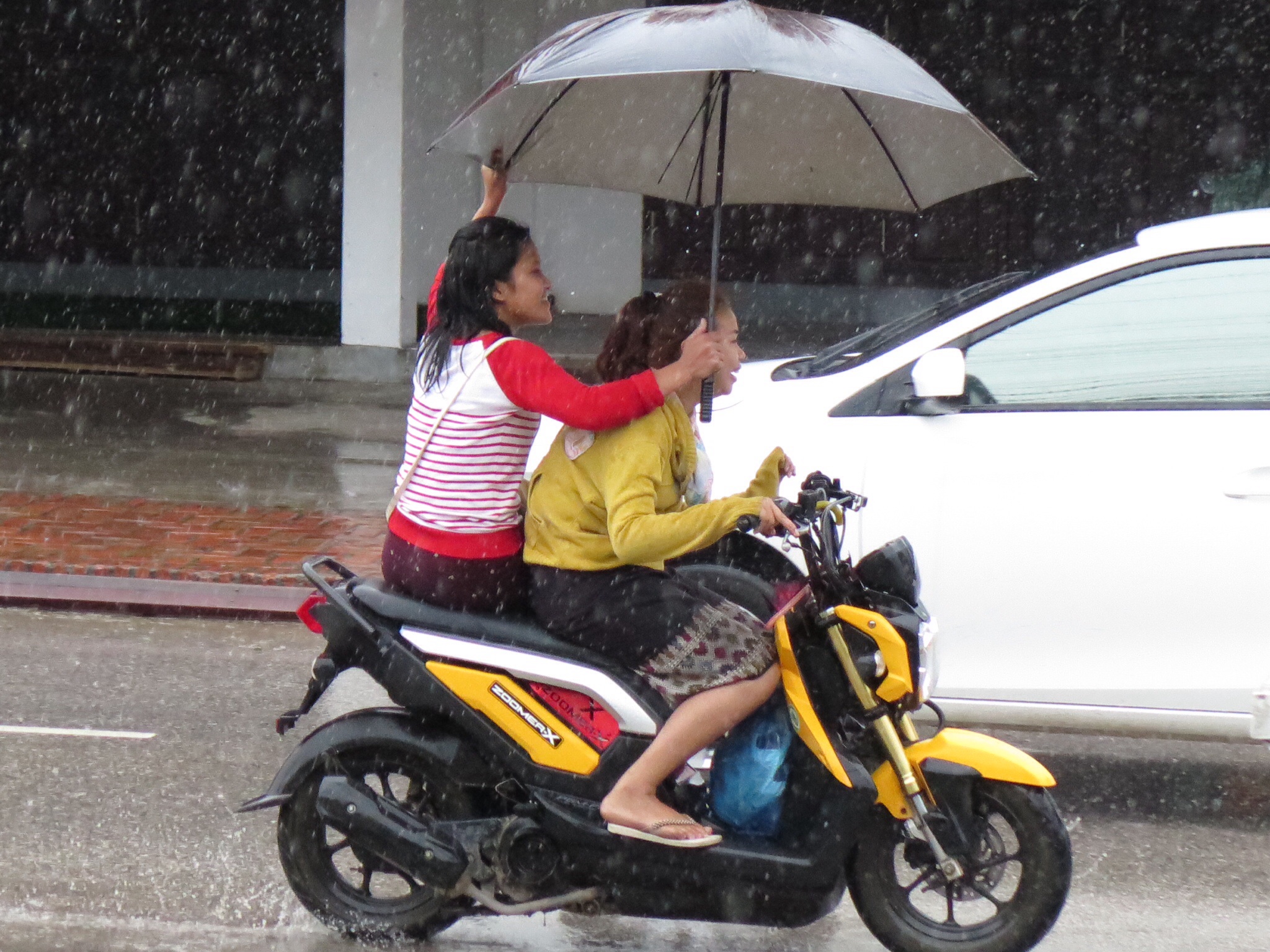
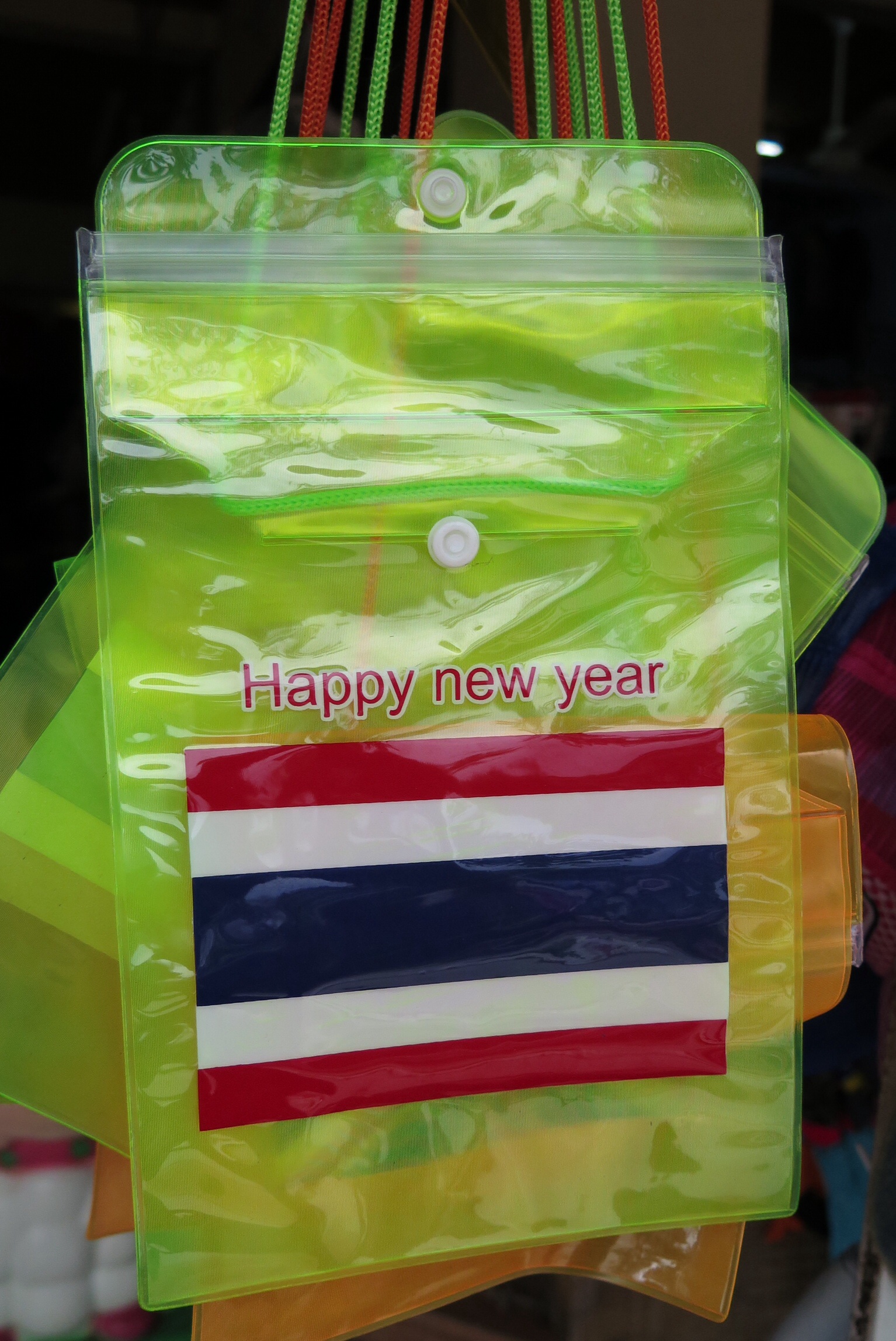
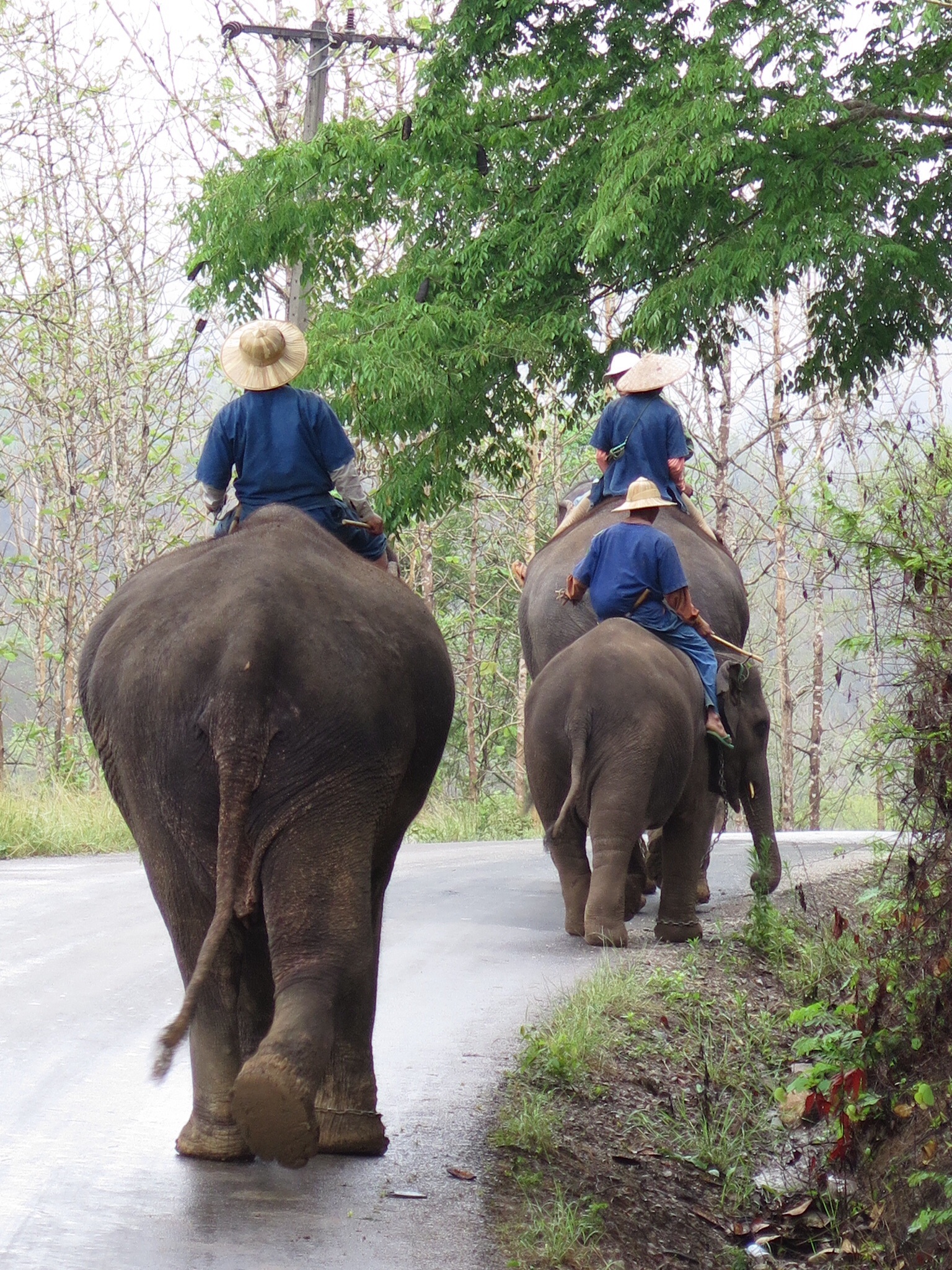
The New Year celebrations are timed to co-incide with the end of the dry season and the start of the rainy season. And when it rains …it rains. This downpour brought with it at least two inches of rain. Fortunately everyone is prepared, umbrellas which ward off the sun for much of the year are simply put to their original use.
Author Archives: trevorllewelyn66
Laos New Year
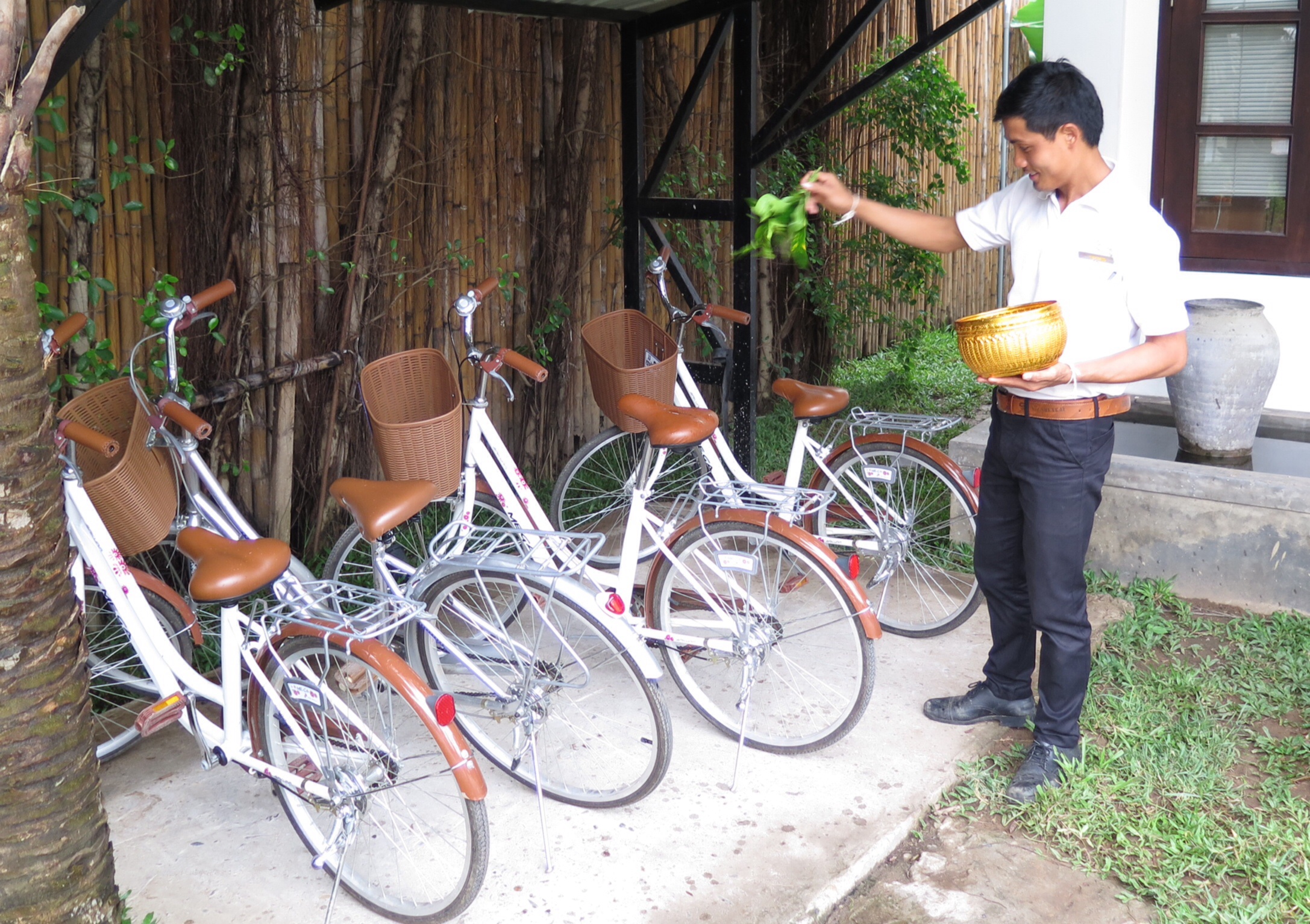
The official festival for Lao New Year (Boun Pi Mai) lasts for three days from April 13 to April 15 so we shall miss the main celebrations leaving as we do today for Hanoi. As in every country in the world a new year is the opportunity to get rid of the old and see in with the new. In Loas this is seen as atime of cleaning and purification and entails a thorough spring clean starting with the Buddha images which are removed from the temples and cleaned with scented water. As you can see our hotel took a more practical approach to cleaning and blessing their stock of bicycles.
Once temples, houses, cars and bicycles have been cleaned the Loatians take to the streets to douse one another a further act of cleansing in anticiapation of the end of the dry season. It is as you can see from the firepower they bring to bear something they take very seriously. For water pistols read personal water cannon – and foreigners are a particular target.
Beats taking the train to work
Tourism at work
Laos is one of the poorest countries on the planet. Currently a third of the population lives below the international poverty line of $1.25 a day. In 2103 the country ranked 138th in the world on its Human Development index and was according to the Global Hunger index ranked the 25th hungriest nation on the planet. It has a poor human rights record and corrutpion in the Marxist government is common place. Against this backdrop however, the tourist industry has, in recent years, grown rapidly. Indeed by 2010, 1 in every 10 jobs in Laos was in the tourist industry.
Apart from the towns where shops, restaurants, hotels, guides and many many others benefit from the tourist industry we experienced just how important tourism is to the people of the countryside where subsistence agriculture still provides 80% of all employment.
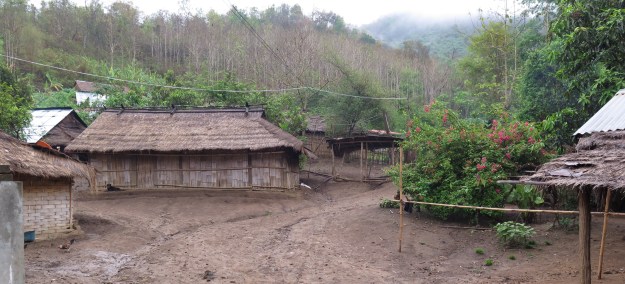
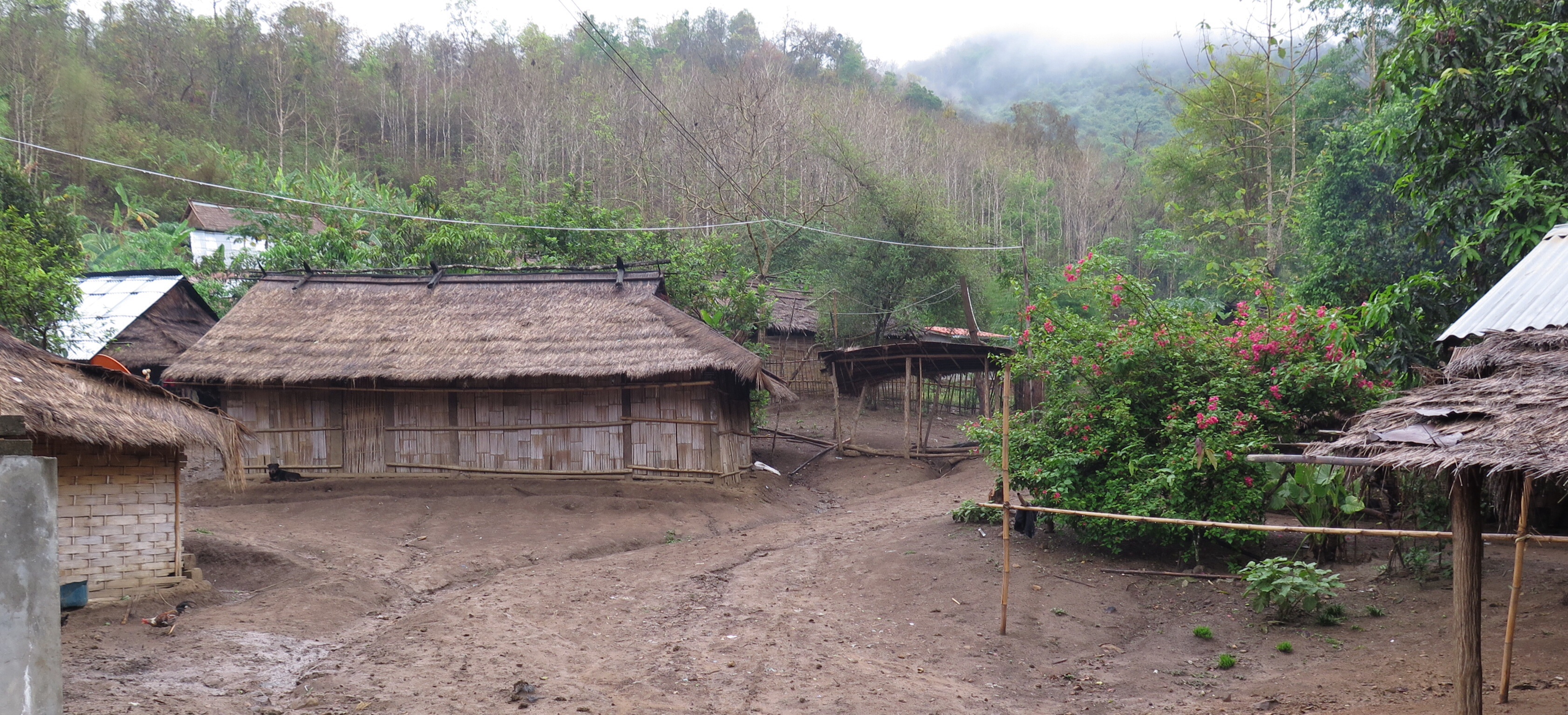
On a trip to the Kuang Si waterfalls an attraction some 25km south of Luang Prabang we stopped at Ban Ou a small village of Lao Lum which has certainly taken advantage of both the growing tourist industry and its position as an ideal ‘stopping off point’ to the waterfalls. Here you can watch locals take you through the process of creating cotton thread from raw cotton with of course the opportunity to buy a small gift at the end – perhaps more interesting was the ‘gift’ of 3 kg of bananas that our guide received in return for our visit. It was never made clear whether the size of the bunch was proportional to the amount of our purchase.
Yards away children sold traditional Laos trinkets – beaded bags and wrist bands for what was for us no more than a few pence although we still think twice about paying out tens of thousands of kip for even the most basic item – there are 8,000 kip to a dollar so the numbers quickly mount up.
The only concrete path conveniently takes you on a route directly through the village. Tradesmen had set up early, we arrived just before 9am, and already a woodcarver was half way through his first elephant of the day. Other stalls were gradually taking shape .
The village though does not just depend on tourism to improve its way of life. The European Union has provided money for basic sanitation projects, most houses now have toilets linked to a main sewage system. It has also provided electricity which, from what we saw, not only provides light but allows the charging of mobile phones whiich as much the must have item here as they are anywhere else in the world. Both these improvments to the villagers way of life has, our guide claimed, helped to reduce the drift of large numbers of youn people away from the coutnryside.
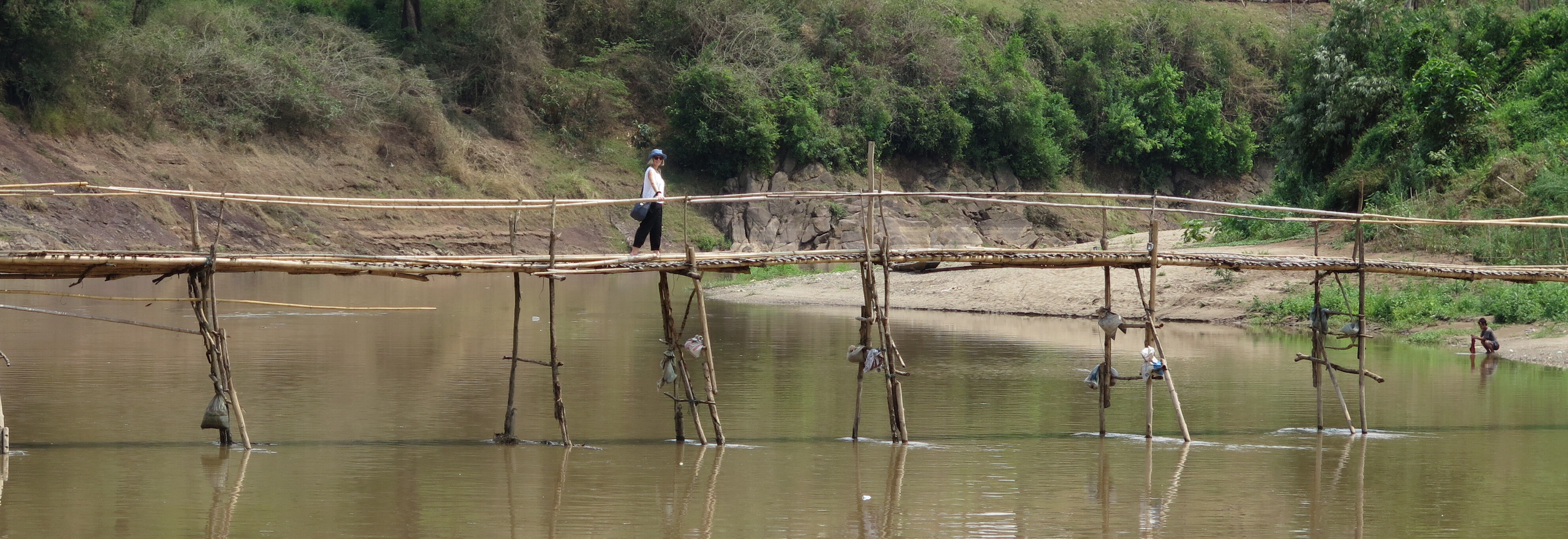
Bridge over the Nam Khan
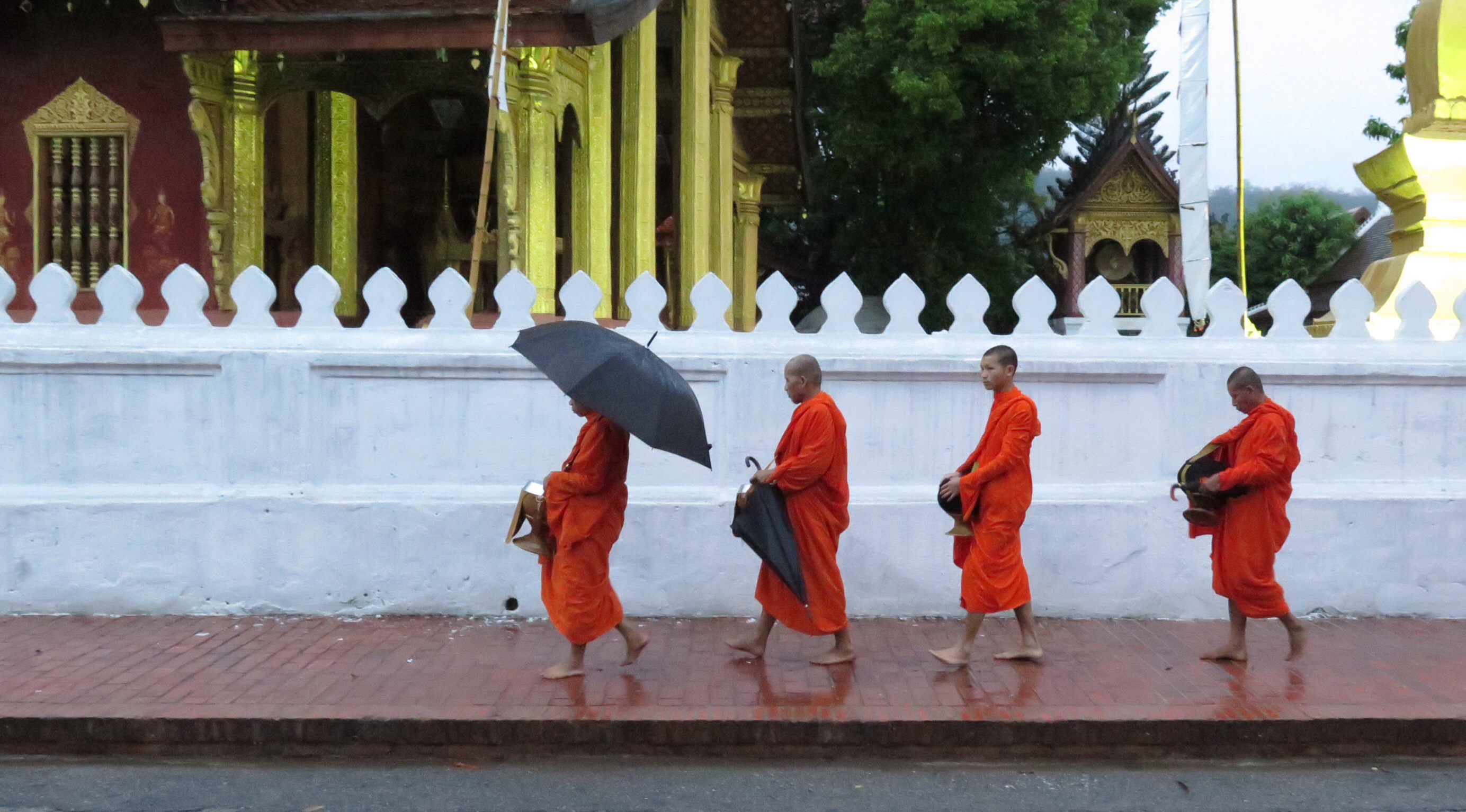
Alms and the Man
It had rained all night. I know because I listened to it unable to get to sleep. Jet lag had caught up with me. They say it is always worse going West to East although I hope, given the fact that there is only a six hour time change, it will quickly wear off.
The monks of Luang Prabang are given alm daily as the sun rises – so there we were with several hundred other tourists and locals to pay our respects and of course take endless numbers of photographs. The monks seem oblivious to what must be an intrusion into a ceremony which is both spiritual and peaceful. They are given gifts, usually in the form of food – sticky rice seemed a popular offering although some people were giving fruit and we even saw sweets being handed out.
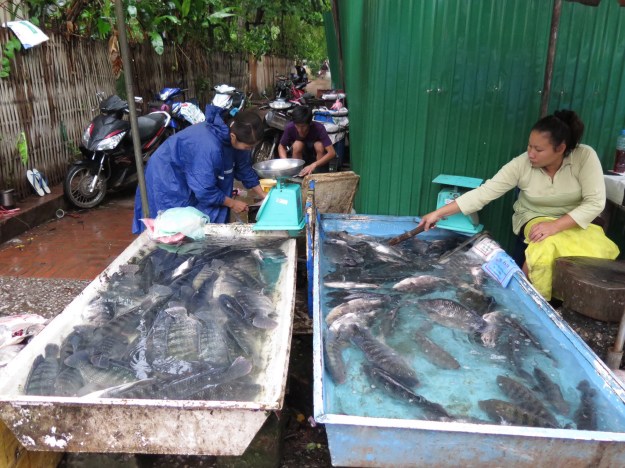
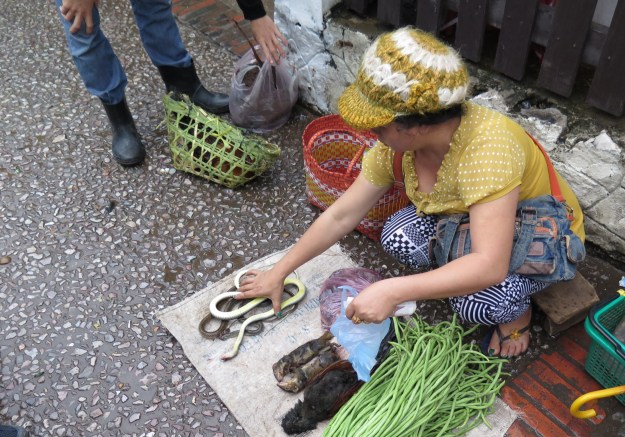
The early morning street market started gently enough with assorted bags of rice, less expected were tiny bamboo caged birds who, if we purchased them, would bring us good luck if we set them free. The heart of the market though brought us face to face with products that you will never find on the shelves of your local Sainsburys. Frogs, alive and dead, cooked and uncooked. Snakes – not venimous we were assured and ours for $4 each. Rats, again cooked and uncooked as were the squirrels. Every possible part of pig conceivable including womb and then there were the pints of buffulo blood in both liquid and jelly form (mixed with what I can only assume was a gelatine equivalent). All this before breakfast.
Luang Prabang Rocks
Le Sen Boutique Hotel where we are staying, is currently being assaulted by music from all sides. The Laotian melody I do not mind, it is the bass notes which really gets inside your skull. Things, I am assured by the French manergeress, will only get worse. It is a point she takes some pleasure in making. If I am going to suffer – as I have done since getting this job three years ago, so are you.
The Laos New Year is celebrated over three days next week primarliy as a water festival but as with any party, music plays a key role – in Laos though and Luang Prabang in particular there seems to be a three day warm up period before the main event event with a dreadful mix of mid 90′ western pop mixed in with traditional Lao folk tunes remixed with a hefty dash of Black Sabbeth.
For the other 360 days of the year it would seems Luang Prabang justifiably earns it reputation as a quiet backwater set in the mountains of Northern Laos. Laid out mostly along a thin peninsular of land that lies at the tributary of the Mekong and Nam Khan Rivers it has been the perfect place to start our joint sabbaticals – mine from my job at Dulwich College and Louise from running her own business.
We have found our favourite restaurant – The Tamarind, surprisingly one of the few Laotian styled eateries to make the top ten places to eat – there is a strong French influence in the town. Among its specialites are a searingly hot buffulo dish – although pure heat is unusual in Lao food which is dominated by sweet and sour flavours brought by palm sugar, garlic, coriander, galangal, lemon grass and thai basil. There are several other aromatic herbs which simply have no equivalent in Britain.
Last night we enjoyed a festive shared meal with other like minded souls. As is traditional in Laos all the dishes – starters and mains arrived together and at a little less than $15 per head proved exceptional value. Sticky rice is the staple carbohydrate in Laos and it was served with tasting bowls of tomato chilli salsa, smoked aubergine paste. chilli green peper, wafer thin strips of dried river weed brushed covered in sesame ( much tastier than it sounds) and super spicy water buffalo skins. The main dish was beautifully soft tilapi – a river fish caught locally and steamed in banana leaves. Desert was more sticky rice – this time purple cooked in coconut milk and sugar served with ripe mango. Heaven on a plate.
Oh my Buddhas
Oan (imagine a Mexican pronouncing ‘one’ and you are pretty close) our guide met us as arranged and upon hearing of the length of our journey uttered the now immortal phrase which simply had to be the title of this post. Apparently just short of 70% of the population are Buddhist (only 1.5% are Christian) which at least offers an explanation of Oan’s version of OMG.
Born and brought up in Loas Oan spent 9 years in Leningrad learning Russian under a Government sponsored programme – Laos has been run by a Marxist and communist government since 1975 before returnig home to find that the blossoming tourist industry needed English speaking guides more than Russian speaking ones – although that is changing rapidly.
Departure
Alarm at 4.15am and pick up at 5.00am. Heathrow 45 minutes later courtesy light traffic, a minicab driven who took no prisoners even at that ungodly hour of the morning and ignored at least three red lights. Oh well it got us to Terminal 3 early enough to be assigned the emergency seats on the first leg to Dubai.
Fast forward twenty four hours and we landed in Luang Prabang International Airport along with a party of identically dressed (in orange t shirts and white tousers) representatives of a Thai cosmetics company – identical that is except for the ‘Gangnam Styled’ video camera wielding party leader and the sulky, sultry Gok Wan lookalike who clearly wanted to be elswehere.
The Loa authorities could not have been more helpful in organising visas and Louise’s EasyJet sponsored bright orange luggage had arrived safely. We had arrived.
The title’s the thing
No not Route 66 aka the Will Rogers Highway a 2448 mile road which stretched across the US from Chicago to Santa Monica in California and a major route west for thousands of migrants in the 1930’s but the number of days Louise and I are away travelling across Indo-China, Australia, New Zealand and Singapore.